

ANIMA (Latin: soul, wind, air)
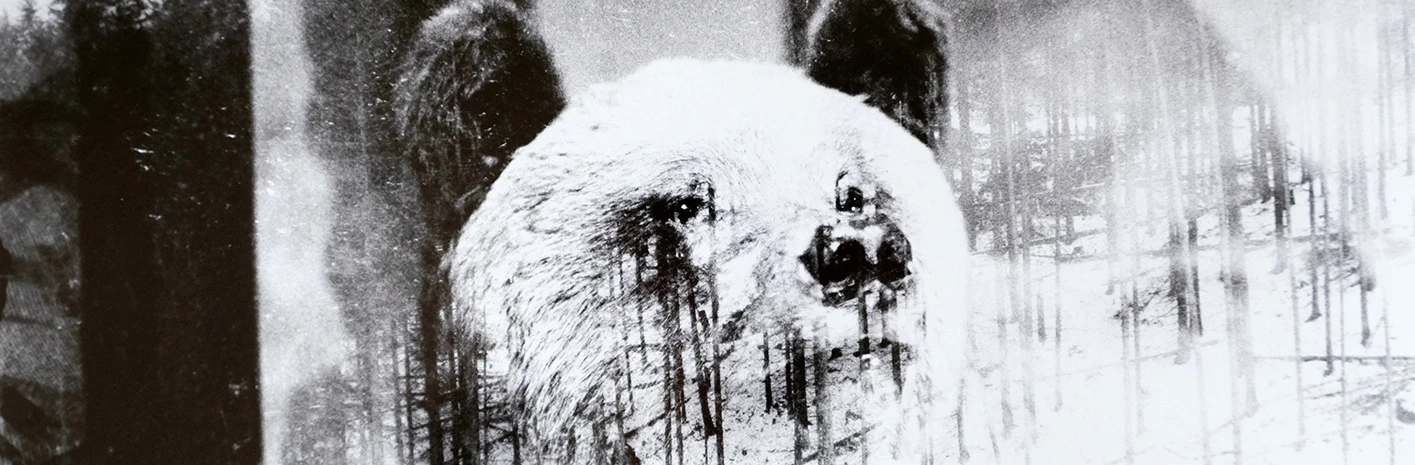
The project consists of a series of black and white analogue photographs accompanied by a soundtrack. Landscapes of Polish national parks and portraits of taxidermied animals have been superimposed on one another.
Work on the series began in Teremiski during a visit to the Camp for the Forest. In 2017 and 2018 the artist travelled through Polish forests and nature reserves (Białowieża Forest, the Tatra Landscape Park, the Krutynia Nature Reserve, the Choczewskie Cisy Nature Reserve, Polesie National Park, Knyszyn Forest, the Las Kabacki Nature Reserve), and then visited ethnographic and hunting museums. One of them was the Wozownia Museum in Kuźnice, which holds the oldest collection of dermoplastic specimens by Antoni Kocyan, from the second half of the 19th century.
"Animals typical of the fauna of Polish primeval forests and woodlands, functioning in museum spaces, are distorted monuments to human hunting trophies. Sometimes captured in a dramatic and unnatural gesture, though intended to imitate life, they lose their former meaning, including the educational one. In the present era of digitisation, when we can commune with high-quality images depicting living animals in their natural environment, the old art of taxidermy finds no justification. Using the technique of double exposure of a frame of film, I want to place the animals back in their natural context. With this artistic gesture I restore to nature what was torn from it, if only by means of an illusory happy ending. At the same time I play with the vision of nature conservation pursued by the ministry of the environment."
The second part of the project is a soundtrack. A musical composition based on the sound of the audiosphere of the fauna of Polish forests. The sound material consists of the sounds of hunting calls (whistles used to lure and shoot animals). Freed from their original task, the calls have gained the function of musical instruments.
The series consists of 18 photographs made in the archival gelatin silver technique on baryta paper. The artist also made the large enlargements herself. The photographs, over a metre in size, are an undoubted treat for lovers of analogue photography.
The activity is carried out as part of the "Mobilni w Kulturze 2021" programme, funded by the City of Warsaw.
Kasia Rysiak
Designer and visual artist. A graduate of the Academy of Fine Arts in Łódź, Faculty of Textiles and Fashion, and of the Faculty of Graphic Arts at the Academy of Fine Arts in Warsaw. Since 2009 she has been active in Warsaw as an interdisciplinary artist, art educator and designer. She ran the clothing brand Mamapiki. She co-creates the Pracownia Wschodnia artists' collective. She ran her own educational and artistic programme FOTONY at the Rozwój w Biały Dzień Association. She is currently developing Foto Pracownia Wschodnia and also designs chess sets www.a00.pl
Antoni Kocyan (1836–1916)
Zoologist, forester, one of the best-known researchers of the fauna of the Tatra Mountains. From 1856 he worked at the ironworks in Kuźnice, later as a forester in the Kościeliska Valley. In 1861 he learned the secrets of preparing zoological specimens. He created the first faunal collection. His scientific works and dermoplastic specimens are today a wonderful source of knowledge about the fauna of the Tatras and contributed to saving many valuable species. Kocyan's collections can be found today in many museums in the Polish and Slovak Tatra foothills. (source: regiontatry.pl)
Installation views


