

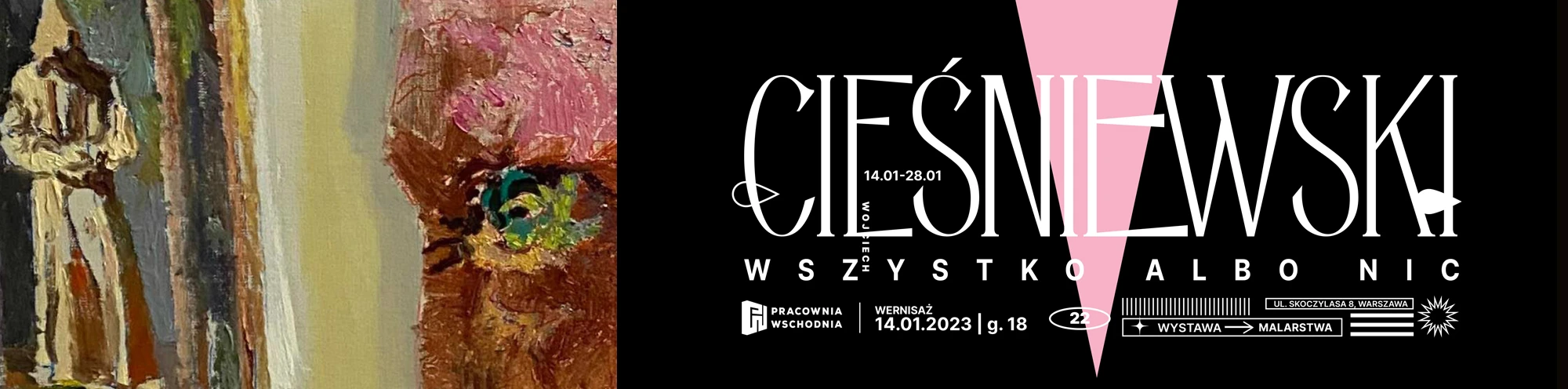
The source of art is commitment. Commitment allows one to create form and give an expression that will fascinate and move people – writes Wojciech Cieśniewski on the back of one of his paintings. The exhibition "Wszystko albo nic" (All or Nothing), organised at Galeria Wschodnia by Mikołaj Chylak and Jan Albert Cieślak, aimed to look at the painter's rich, long-standing body of work. It is not a typical retrospective exhibition, in the sense that it does not set out to discuss the individual stages of Cieśniewski's oeuvre. It is intended to go beyond the details and capture that "something" which defines him as a human being and as an artist.
Cieśniewski, who completed mathematics studies before becoming a painter, often seeks rationalisation for his highly emotional work. He makes continuous attempts to define art and beauty, which he often records as slogans and explanations on the reverse of his works. However, as the curators note, in his artistic practice he goes beyond the assumed theses, ultimately letting himself be carried away by intuition and vision leading him sometimes into unexplored regions. As artists themselves, it is precisely this artistic passion, the non-obvious side of the act of creation, that seems most interesting to them.
Cieśniewski started with forms close to abstraction, following his teacher, Rajmund Ziemski. Over time, he moved towards figuration, striving for greater clarity and communicativeness of the image. However, this did not change the direction of his artistic searches. Both his earlier abstractions and figurative works are characterised by expression and emotionalism. Looking at nature, man, and history, he seeks a visual form for his feelings. A form that, as he says, "will move people and give them beauty". His painting is close to the attitudes of Cézanne or Van Gogh, whom he himself recalls – artists who paint exclusively as they see and feel. In his works, Cieśniewski wishes to express his feelings towards the world: his delight and his pain. Seeking a direct flow of emotion, he sometimes paints with the lights off, in the dark. His practice involves returning to the same theme several times, which aims to achieve better expression while demonstrating that the artist's feelings develop during the act of painting itself.
In recent years, Cieśniewski has increasingly turned towards ethical issues and posed questions concerning the fate of man. A recurring theme in his work is the difficult history of his own family and his hometown, Działdowo in Masuria, playing out in the shadow of fascism and post-war communist reality. Following this, he addresses various threads from the tragic history of the 20th century, expressing solidarity with the victims of persecution and totalitarianisms. He paints with empathy. In his paintings, he captures fleeting gestures, recalls events and their consequences. A common formal device is dividing the surface of the painting into various loosely connected compartments, "windows", which allows for juxtaposing different motifs and perspectives, highlighting deeper psychological or moral relationships.
Many self-portraits could be seen at the exhibition, in the background of which appear works or images of other artists or historical architecture. For art, though not contemporary, is his universe. His gaze is mainly directed towards the works of European Renaissance and Baroque artists who turned to nature and were guided by their own vision. His favourite destinations are Italy and Spain. These references constitute a kind of statement about his philosophy of art. He is not attracted to the spiritualised anti-naturalism of icons. It is in the visible, material world that the drama lies for him, serving as the starting point for the artist. He is also particularly close to the beginning of the 20th century, when painting brought a new perspective and reflected the pulse of a changing world. He is not interested in other, contemporary forms of artistic expression, new media, or the changing circumstances in which art operates today. For Cieśniewski, art, and especially painting, still holds the power of a weapon. In his artistic idealism, one can discern a touch of Don Quixote, transporting us to the times of painterly knighthood. His attitude is marked by an uncompromising nature. All or nothing. As he says himself: "Viva l’arte means ‘let the heartbeat be the most important’!"
Text author: Tamara Sztyma
Curators: Mikołaj Chylak | Jan Cieślak
Installation views


